


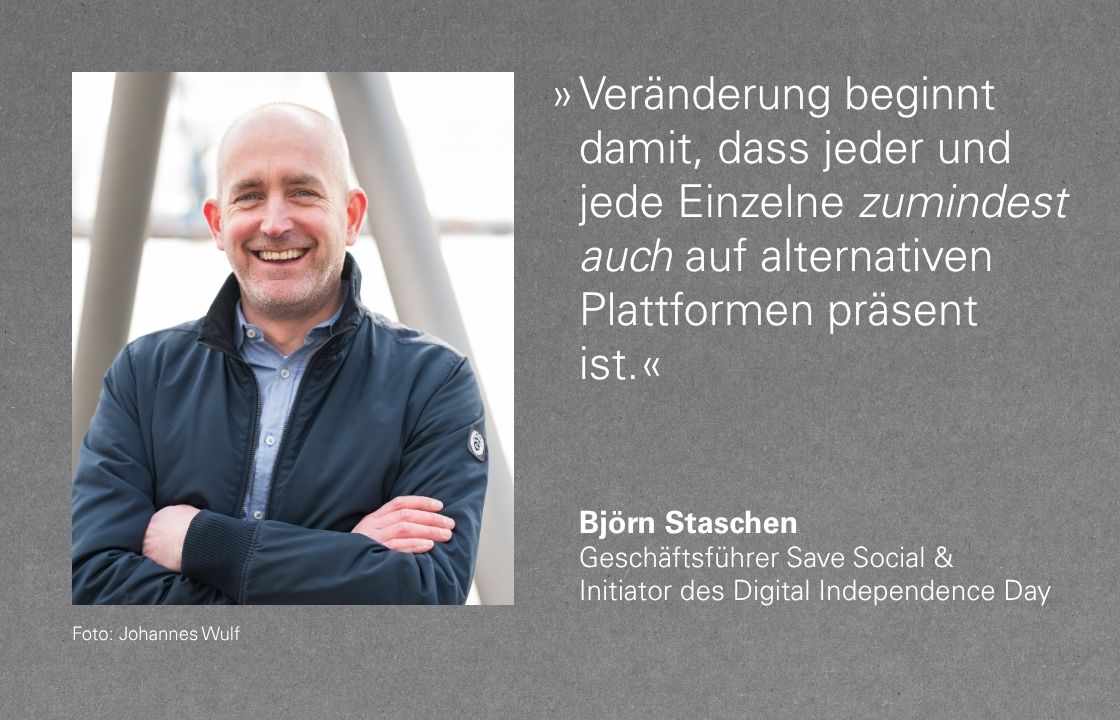
The Digital Independence Day (DI.DAY) calls on people on the first Sunday of every month to become more independent of platforms run by major tech companies and explore alternatives. The DI.DAY was launched at the beginning of 2026 by the non-profit initiative Save Social. Together with more than 40 other organisations, the Schöpflin Foundation joined the group of initiators. Time for an initial review: How has the Digital Independence Day developed since its launch? And what role do digital sovereignty and alternative platforms play for democracy and civil society? We spoke to Björn Staschen, initiator of the DI.DAY and Managing Director of Save Social, about these questions.
1. At the beginning of the year, you launched the Digital Independence Day (DI.DAY). What has surprised and encouraged you most since then?
Björn Staschen: It is fantastic to see how something like a movement is emerging, how more and more people are taking a step towards digital independence on the first Sunday of every month. We are deliberately trying to organise the DI.DAY in a decentralised way. We do have a central website with our switching recipes, but above all, we make our materials, the DI.DAY logos, colours and fonts available to everyone who wants to get involved. And we help with organising: through our calendar and our network of experts. For example, events are being organised in libraries, adult education centres are taking up the topics, and entire schools or community centres are getting involved. The idea is also spreading internationally: our website is available in English and Italian, with French to follow – and there are groups in Ireland, France, Portugal and even Colorado, USA, taking part with events.
2. Digital sovereignty is often perceived as a cumbersome, technical topic. Why is it also an important issue for us as a democratic society?
Björn Staschen: These days, we are all aware of how dependent we are on a handful of companies: the more we do on our phones, the less we can do without Google, Apple, Amazon, Microsoft, Meta, TikTok (ByteDance) or OpenAI. These companies collect all the data they can get their hands on in order to massively expand their AI applications, regardless of the consequences or risks – with unforeseeable consequences for our societies. And when a company like Microsoft can decide that a person, for example the former chief prosecutor of the UN War Crimes Tribunal in The Hague, can no longer receive their emails, that restricts the freedom not only of the individual, but of society as a whole. So there are two levels: one on which individuals can regain freedom and experience their own agency through individual digital switches, and a second on which politicians urgently need to take action. The DI.DAY sends a signal: There is a lot of support among voters for such political demands!
3. Every month, the DI.DAY initiative recommends a »switching recipe« – away from the monopolies of the major tech companies and towards smaller, preferably ad-free and European alternatives. How have these switching recipes been received?
Björn Staschen: The response has been huge: More than 100,000 people use our switching recipes every month. Many people ask for more recipes by email – and based on the frequency of these requests, we provide two or three new ones each month in different categories, from entertainment to office organisation. The alternatives to Spotify have been accessed most frequently, while our recommendations for switching calendars and contacts, as well as maps for navigation, are also being used tens of thousands of times.
4. One alternative is the social media platform Mastodon. Since spring, the Schöpflin Foundation has been communicating on its own Mastodon server together with other foundations. You supported us in taking this step. How can foundations and civil society organisations in particular benefit from these alternative platforms?
Björn Staschen: We are delighted that more than 20 foundations are now in contact with around 10 million users on the open Fediverse network. The foundations themselves decide the rules according to which they communicate on their server: It is not a US corporation that determines what is allowed and what is prohibited, but each user themselves. The foundations’ content reaches the people who have subscribed to them directly – without algorithmic distortion. And by operating their own server, foundations are helping to create a real alternative to the Big Tech networks. This is also a political signal: The more institutions, organisations, associations and municipalities operate even a small piece of infrastructure themselves, the more realistic the possibility becomes of creating genuine alternatives to the monopoly data vacuum cleaners of Meta & Co.
5. Looking ahead to the next five years: Where and among whom would you like to see the idea of the Digital Independence Day have an even stronger impact in the long term?
Björn Staschen: We very much hope that companies – both small and large – will also take up the idea of the Digital Independence Day. In my vision, even a bookseller like Thalia or a company like Otto would advertise the fact that their own services contribute to greater digital sovereignty. And national and state governments, municipalities and organisations follow the »Plus-One Principle« advocated by Save Social: No one communicates only on Big Tech platforms anymore. Change begins when each and every individual is present at least also on alternative platforms. This change urgently needs to begin now, given the growing power of the monopolies. We need to stop this shift in power if we want to preserve our democracies.


