


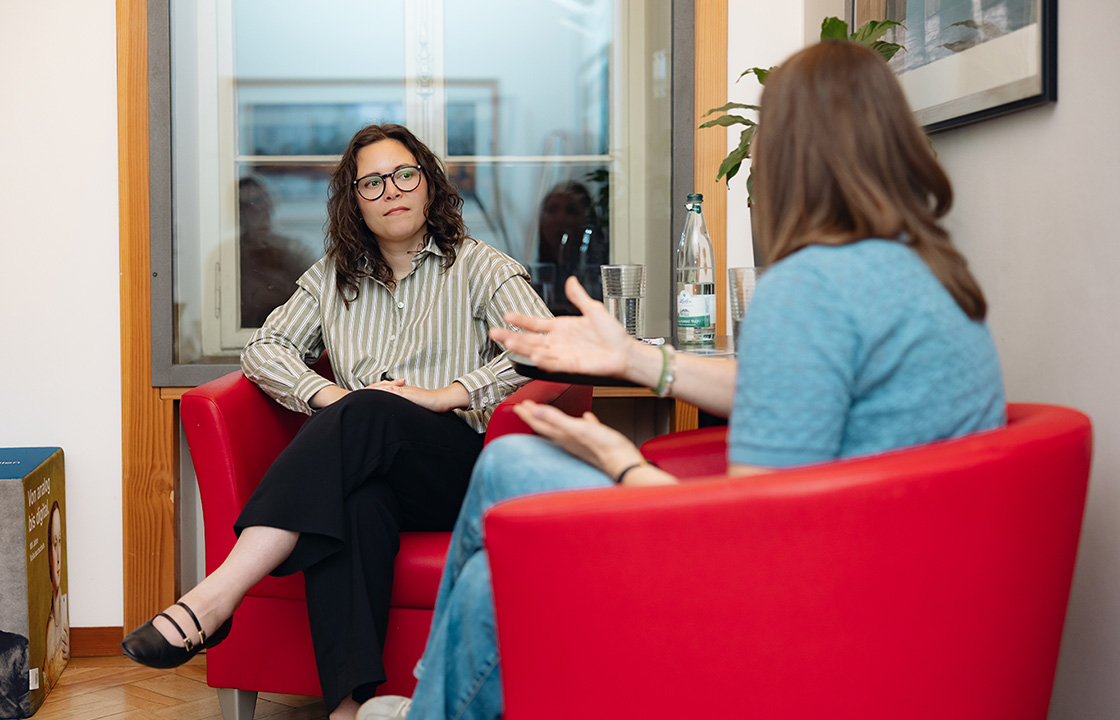
Babies who die shortly before or after birth are known in German as »Sternenkinder« (literally, »star children«). This relatively rarely discussed subject is where Anna Schiller, a journalist with the Neue Zürcher Zeitung (NZZ), and Nadine Brand, a healthcare and paediatric nurse, begin their conversation. Brand’s work at a hospital in Lörrach also involves supporting families who have lost a baby. She talks about this and other experiences from her daily work, speaking openly about the difficult aspects of her profession: less funding for healthcare, a heavy workload and more and more people leaving the profession as a result. But she also talks about the rewarding moments: being there for people during the first hours and days of a new chapter in their lives. »I enjoy this work. It gives me so much in return,« Brand emphasises.
»Not just talking to CEOs, politicians and celebrities«
The conversation is part of the project »Volkes.Stimmen – Democracy in Motion«, supported by the Schöpflin Foundation and the Gemeinnützige Hertie Foundation. The project was launched by journalists Helene Bubrowski, Editor-in-Chief of Table.Briefings, and Simon Strauss of the Frankfurter Allgemeine Zeitung (FAZ). They have brought together a dozen journalists, including contributors from WELT, FAZ and Deutschlandfunk, for »conversations about everyday life and the state of our country«, as the project’s subtitle puts it. They meet people in their own communities, particularly in rural areas, gaining insight into their everyday realities. Journalists often report on political developments in Germany, seemingly taking the perspective of the public. But is that really the case? What actually matters to people in Germany? What concerns and hopes shape their views on politics, journalism and democracy? And do these perspectives receive enough attention in media coverage? These questions prompted the launch of »Volkes.Stimmen«.
Journalists meet people where they live
NZZ journalist Anna Schiller (34) and paediatric nurse Nadine Brand (47) meet for the first time one evening in early October in Lörrach. Seated opposite each other in red armchairs, Schiller welcomes the audience: »The idea behind Volkes.Stimmen is simple: journalists based in the capital don’t interview CEOs, politicians or celebrities for once. Instead, ‘ordinary’ people talk about themselves, their perceptions of politics and the issues that matter to them.« In the case of Anna Schiller and Nadine Brand, this means discussing the planned legislative reform in the care sector, how newly qualified staff are introduced to their jobs and everyday life on the hospital ward. One issue runs through much of their conversation: the lack of time. Brand explains that there used to be more people on the ward to support her and her colleagues in caring for patients. »They restocked cupboards, tidied rooms and helped with documentation. Today, we have to get more work done in the same amount of time – which often means we have less time for caring for and advising our patients,« she says. Brand would like to see three things from politicians above all: greater recognition for her profession, more staff and a reimbursement system that takes patients’ different needs more fully into account instead of calculating everything at flat rates.
Around a dozen conversations and a healthy dose of idealism
Direct exchanges like this between journalists and members of the public took place at adult education centres across Germany in 2026, making use of these institutions as places for people to meet and connect, explains Claus Lüdenbach. He is head of the Esslingen Adult Education Centre and one of the project’s initiators. Anna Schiller and Nadine Brand meet in Lörrach as part of the Long Night of Democracy. Their conversation is one of more than 20 events exploring democracy that evening. The journalist listens attentively to her conversation partner and asks follow-up questions. There is no list of questions or recording device in front of her. Unusually for journalistic practice, the conversation is not intended to result in an article or broadcast. At the end, Schiller reflects: »When I travelled here, I knew what you know as a patient. I’ve learned a lot – that’s what’s so great about this project.«
What motivates her to take part? »A healthy dose of idealism,« says Anna Schiller. She travelled from Berlin to Munich and Lörrach for her conversations. »You rarely just approach people on the off chance and ask them: What’s on your mind?« But for her, there is more to it: »I do think it’s incredibly important for people to see themselves reflected in the media. This vague mistrust of the media may also stem from the fact that people only ever see politicians, experts and journalists on TV.« For healthcare and paediatric nurse Nadine Brand, the conversation is a welcome opportunity to tell people from other professional fields about her work and answer their questions. After the conversation, she and Schiller exchange contact details.
»I learned more about democracy than in many years in the Bundestag«
The two conversations Schiller had during the project have given her food for thought: »What really stood out to me was how engaged my conversation partners are and how closely they follow major societal issues: antisemitism, and health and care. These topics are constantly debated in Berlin. And yet neither woman felt that the heart of the problems was being recognised and discussed there. That worries me.« Adult education centre director Claus Lüdenbach draws a positive conclusion: »Volkes.Stimmen has achieved what we set out to do: it has brought journalists into contact with people where they live.« He has also received a great deal of positive feedback from the journalists. One journalist wrote to him: »I learned more about democracy through this project than I did in many years in the German Bundestag.«