


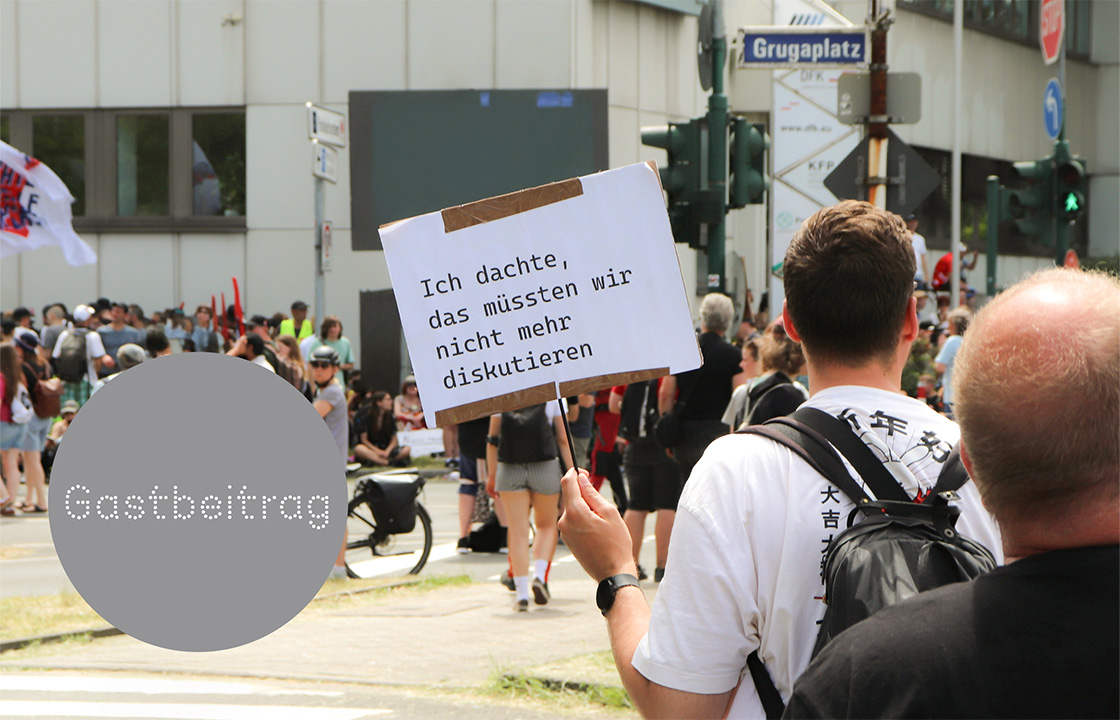
A guest article by Wolfgang Kaleck, Co-founder and general secretary of European Center for Constitutional and Human Rights (ECCHR).
It goes without saying that we should learn from history. For enlightened audiences, at least, that seems obvious. But are the comparisons between today and the Germany of 1933 historically appropriate and politically helpful?
Those who currently claim it’s »5 minutes to 1933« (like German art activist Philipp Ruch) or »Just like 1933« (such as the election poster of the Social Democrats’ youth wing, »Jusos«, in Berlin), are comparing Germany's Nazi history with today’s rise of the far-right Alternative for Germany (AfD). There is no doubt that the AfD represents right-wing extremist, racist and anti-democratic positions and has established its strength as a party that can rally a broad spectrum of voters – from neo-Nazis to right-wing conservatives and libertarian elites.
But why should the Germany of the Weimar Republic be a reference point for this alarming development? Why not Sweden, Austria or France, where right-wing extremists have enjoyed similar success? Or the latest developments in the United States under President Donald Trump, Vice President J.D. Vance, and Elon Musk?
A look at historical analyses can be revealing. After Germany was proclaimed a republic in November 1919, democracy faced resistance from key pillars of power in the Weimar era. The military, police, judiciary, elements of business and political parties all rejected the republic or fought against it using violence for years. Hundreds of thousands of men had learned to bear arms in the World War I, many of whom came home with serious psychological injuries. The »authoritarian character« so constitutive for the crimes of National Socialism, as described by Theodor W. Adorno and Klaus Theweleit (in his seminal work, Male Fantasies(Männerphantasien)), was widespread across trade unions and social democracy. The Weimar Republic was ripe for attack before the NSDAP gained a relative parliamentary majority in the November 1932 elections. We definitely haven’t reached that point in 2025, even if we are not democratic enough and probably never will be.
The fact that the Trump government is pursuing fascist policies and the AfD is to a large degree an openly fascist party does not contradict this observation. The mere recognition of this state of affairs forces us to think and act, and it must not be trivialized. That is why we must heed the concerns of those who believe we are on the verge of 1933. AfD voters, like the remaining 80% of the electorate, must be warned of the likely consequences of an ever stronger AfD and be mobilized against this development.
In the name of sustainable politics, however, we should pay more attention to the dictum of philosopher and sociologist Max Horkheimer: »Whoever is not willing to talk about capitalism should also keep quiet about fascism.« In addition to the clearly reasonable mass demonstrations against fascism, we must above all conceive a political vision that addresses the causes of today's crisis of democracy and rule of law. What we need is a social and economic concept that counteracts pernicious inequality and takes into account the concerns of those who are socially disadvantaged and who feel threatened by social decline. That means creating affordable housing and providing health, education, cultural participation and mobility as well access to public spaces for all people who live in Germany.
The opportunity for a better life should not just be reserved for the upper classes. Democracy certainly requires a constitutional state that acts against breaches of the law in accordance with the rule of law and enforces the rules when necessary. But the fight against the AfD and fascism is too important a political challenge to be left to regulators, the police and the courts alone. Democracies do not fail because of too much freedom, but because of too little.
![[Translate to Englisch:] Wolfgang Kaleck](/fileadmin/_processed_/5/b/csm_Web_Portrait_Wolfgang_Kaleck_credit_Nihad_Nino_Pu%C5%A1ija_c59d0d74ed.jpg)